
Fishing Lure Reverse Engineering
This fishing lure reverse engineering subproject focused on capturing and reconstructing the geometry of a curved fishing bait. First, we analyzed the physical object and its surface behavior. Then, we created a precise digital model that could support redesign and production. As a result, the workflow provides a reliable way to transform complex product shapes into usable engineering data.
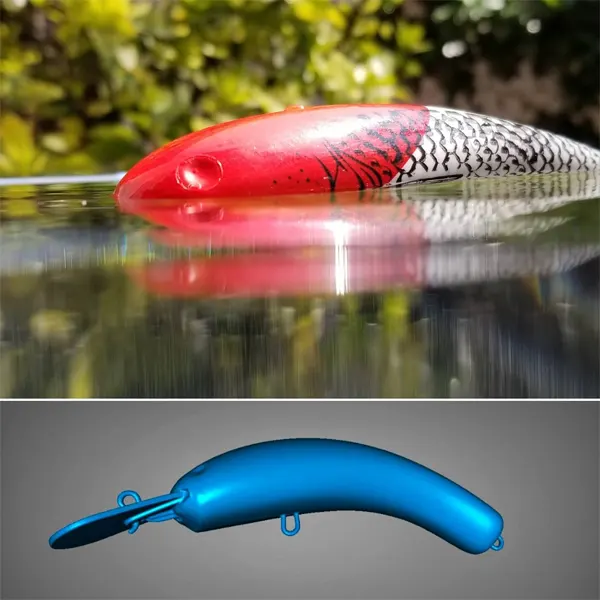
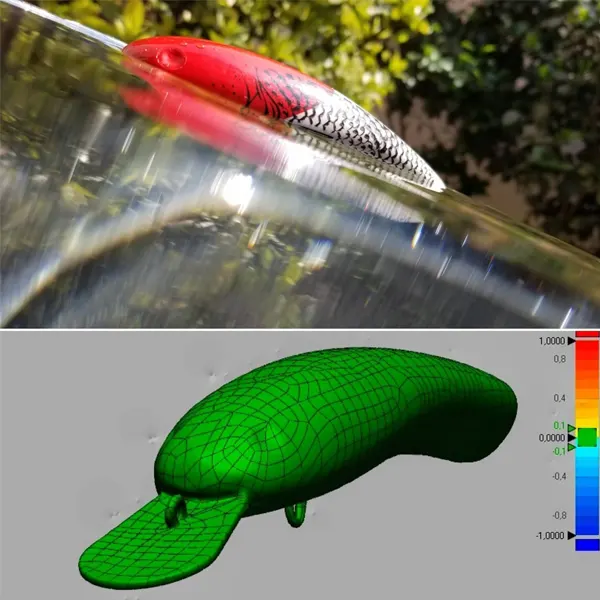
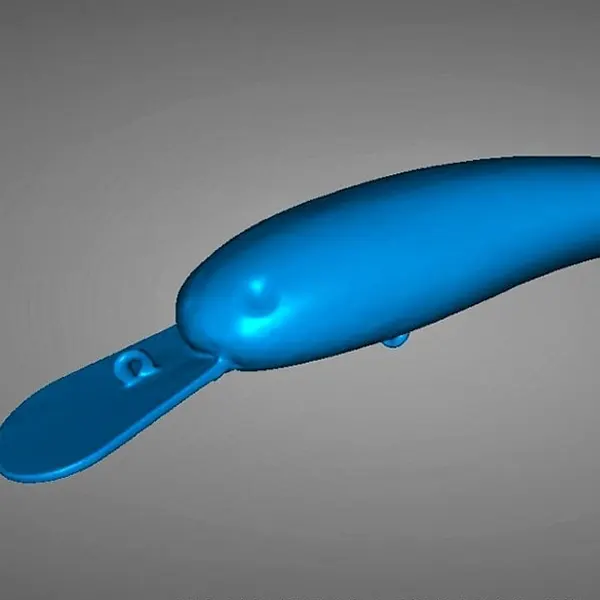
Accurate Capture of Organic Product Geometry
The fishing lure has a smooth and curved body. Therefore, it requires precise capture and stable alignment. First, we scanned the object using a controlled setup. Then, we checked the data for noise and missing areas. As a result, we obtained a clean base mesh. This approach follows the same principles as our 3D scanning services.
Key Technical Tasks
- Capture smooth curved surfaces with stable geometry.
- Remove noise from reflective or glossy areas.
- Prepare mesh data for CAD reconstruction workflow.
From Scan Data to CAD Model
After scanning, we processed the mesh and improved surface quality. Then, we converted the data into a structured model. This step is critical for scan to CAD fishing lure workflows. Instead of using raw mesh only, we created geometry that supports editing and production. Moreover, this process allows accurate comparison with the original object. Similar workflows are used across our projects and services.
Why CAD Reconstruction Is Important
A CAD model gives more control than a mesh file. For example, it allows dimension checks and shape adjustments. In addition, it supports manufacturing processes and testing. Therefore, companies can redesign or optimize the lure before production. If needed, the model can also be used for 3D printing.
Practical Outcome of the Fishing Subproject
The final result is a clean and accurate digital model of the fishing lure. It reflects the original shape and surface transitions. As a result, the model can be used for redesign, analysis, or prototype creation. Moreover, the workflow shows how reverse engineering supports product development with complex geometry. To discuss a similar task, you can contact us through the contact page.
Project Summary
Scope: 3D scanning and reconstruction of a fishing lure with organic geometry.
Output: mesh data, cleaned surface model, CAD-ready geometry, and prototype-ready file.
Use case: product redesign, shape analysis, and preparation for manufacturing or 3D printing.
Project FAQ
What is fishing lure reverse engineering?
It is the process of capturing and rebuilding the geometry of a fishing lure to create a usable digital model.
Why is 3D scanning important for lures?
It allows accurate capture of curved shapes that are difficult to measure manually.
Can the model be modified after reconstruction?
Yes. A CAD model can be edited, optimized, and adapted for production.
Can the lure be reproduced with 3D printing?
Yes. The reconstructed model can be used to create a 3D printed lure prototype.